Decider® Personality science, directly.

Personality Analytics, AI-Free.

For Talent Management and Pre-Employment Assessment

chrome ready safari ready firefox ready passkey ready
Decider was the first in the world to put Big Five-based mutual personality ratings※ into practical use.
By dramatically expanding the ability to assess consistency in personality evaluations, we have created a comprehensive framework that goes far beyond conventional pre-employment assessments.
* According to our research, as of July 2023
Track Record of Over 65,000 Assessments
Why Decider ?

AI-Free People Analytics

Hiring and placement are decisions that shape an organization's future.
It is the organization's responsibility to define whom it needs, what matters, and how to evaluate people—to understand each individual and make its own choices.
Decider puts this principle first.
People AnalyticsMatching & AI Decisions
Trait descriptions from people analytics Overall AI-generated matching score
Output
Individual trait scores take center stage; descriptive profiles
Overall scores take center stage; rankings
What You LearnWhat kind of person is this?Who is the best match?
Decision-MakingPeople choose peopleScores choose people
Decision CriteriaCriteria determined by the organizationBlack-box calculation logic
Applicable Services AI recommendation features, matching-based personality tests, and aptitude tests
Success

Customer Stories

Proven Across Public Companies and Startups.
i-mobile Co., Ltd.
Mari Sudo
We were looking for an assessment to bring objective data into multifaceted interview evaluations and establish a shared language among interviewers.
UT Group Co., Ltd.
Kunihiro Kondo
The biggest benefit is the time saved. This matters enormously to us as our hiring volume increases every year.
Findstar Co., Ltd.
Satoshi Tsuda
Although we had established criteria for evaluating people, we were concerned that interviewers might interpret them differently.
Big Five

Understand Business Through the Big Five

Decider® measures the five Big Five personality traits. Continued research in management has produced encouraging findings in the following areas.
What the Big Five Can Tell Us
  1. By analyzing the nature of a job, we can estimate which personality traits contribute to performance and at what levels.
  2. When assigning someone else to a role, the Big Five can help predict job performance.
  3. Work that is fundamentally mismatched with a person's Big Five profile cannot necessarily be overcome through effort, and may lead to maladaptation, including excessive strain.
  4. The traits that make someone likely to be chosen as a leader differ from those that make a leader effective.
  5. Personality ratings by others predict job performance better than self-ratings.
There is a reason the Big Five is easy to understand.
Research has repeatedly shown that its scores capture the personality characteristics people perceive most clearly.
Concise Definitions of the Big Five
Trait Description
1Conscientiousness The degree to which a person adheres faithfully to established rules.
2Emotional Stability The degree of intensity and persistence of negative emotions.
3Openness The degree of complexity, breadth, depth, and distinctiveness expressed in a person’s associations and behavior.
4Extraversion The degree to which a person engages energetically with the social and material world.
5Agreeableness The degree to which a person tends toward social connectedness or isolation in relation to others.
Common Misconceptions About Scores

The Big Five expresses personality in numbers. Yet the meaning of those numbers is often misunderstood.

One misconception is that a higher number must always be better.

Consider a different kind of measurement: temperature. Under ordinary conditions, steam can be above 100°C, while ice can be below 0°C.
Does that make ice a bad thing?

We spend considerable time in elementary science and social studies learning to describe the world objectively with numbers, just as we do with water temperature.
In practice, however, many adults lack this elementary numerical intuition.

The Big Five results shown in Decider express fairly straightforward facts.
As is widely understood in data analytics, raw data is only a starting point. Insight accumulates through the depth of concrete examples, comparisons and workflows taken together.

One reason it has been so hard to feel confident in assessing people is that personality has been described through disparate, proprietary terms and scoring systems.
Easy

Rediscover Your Eye for People

Decider describes individual characteristics in just five scores, making them intuitively understandable.
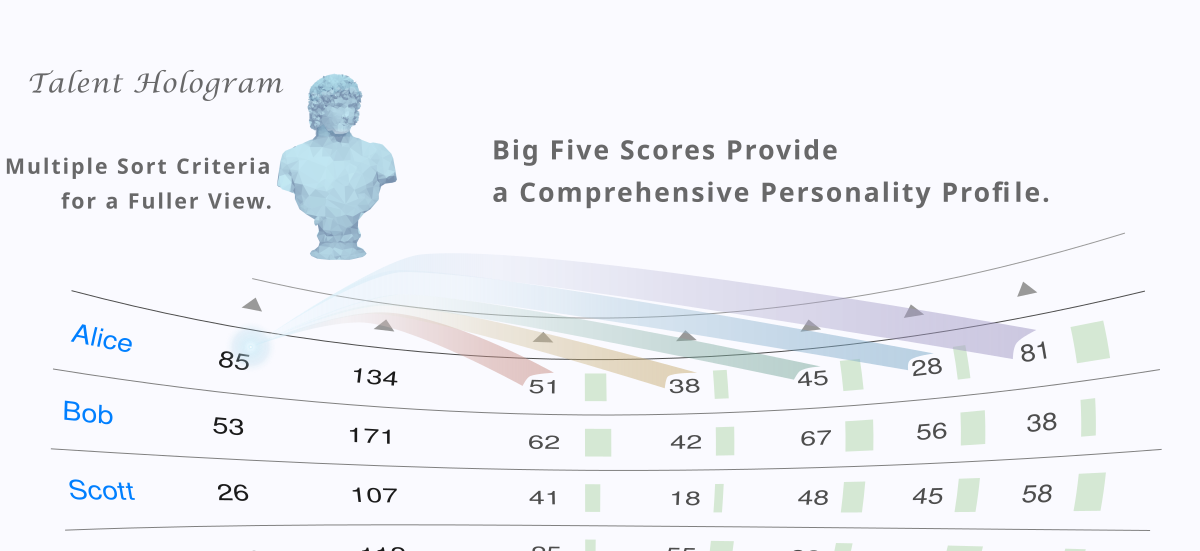
It also offers the Talent Hologram™, which combines all five scores according to your purpose and provides a convenient sorting dimension.
Talent Hologram™ displays combined values alongside the underlying Big Five scores without losing individual detail
Because it is directly linked to the underlying Big Five scores, you can see what the person is actually like at the same time. Specific considerations such as “highly extraverted and assertive” or “low emotional stability and difficulty handling demanding customer relationships”are never buried beneath an overall assessment。
Decider also includes a Tutorial feature that interactively explains how to interpret report scores.
Companies introducing talent management for the first time and newly appointed recruiters can learn the essentials of analysis at their own pace.
It's simple: start the tutorial for your scenario, click “Next,” and follow the explanations step by step.
Decider was the first in the world to put Big Five-based mutual personality ratings※ into practical use.
By dramatically expanding the ability to assess consistency in personality evaluations, we have created a comprehensive framework that goes far beyond conventional pre-employment assessments.
* According to our research, as of July 2023
Track Record of Over 65,000 Assessments
psychology
Big Five Measurement
passkey
Passkey ready
query_stats
Objective Comparison with External Distributions
groups
Comparison with Existing Team Members
sort
Rank and Sort by Measure
precision_manufacturing
Role-Specific Talent Hologram
folder_shared
Report Classification & Sharing Controls
download
CSV Export
devices
Multi-Device Support
FAQ

Frequently Asked Questions

Does Decider provide pass/fail decisions?

No. Decades of research have shown that meaningful pass/fail criteria cannot be established without considering the nature and requirements of a specific job.

Decider aims to help organizations identify and clarify those criteria through analytics.

People have many different characteristics. A trait that is a strength in one job can be a concern in another. Even for the same person, effectiveness depends on the role, supervisor, team, customers and ways of working.

When using automated rankings, including AI, it is essential to check what the underlying data represents, whether the measures actually exist, and whether weakly related indicators have been mixed in.

Even when a model is trained on previous hiring decisions, employment records and performance reviews, past decisions are not necessarily desirable for the future. An aggregate ranking may also conceal why someone ranked highly or what important concerns remain.

Assessment results are evidence to help you think about people. Rather than compressing a person into a single answer, an organization should understand who the person is and make its own recruitment and placement decisions.

By repeatedly comparing these decisions with their outcomes, the organization develops knowledge of which people succeed in which kinds of work. Decider does not aim for a world where AI or a test chooses people. It aims for organizations that can choose people themselves.

Our interviewers disagree in how they evaluate candidates.

This is precisely where the Big Five works best as a common language. Standard dimensions such as extraversion, conscientiousness and emotional stability make it easier to explain why someone was rated highly or which characteristics raise concerns.

A major source of disagreement is the illusion that phrases such as “proactive,” “good communication skills,” or “cultural fit” identify something definite. Although these words exist, there is often no single corresponding psychological factor behind them. This is another indirect lesson of Big Five research.

Tools offering many proprietary measures and evaluation categories can make matters worse. Replication studies of existing products have consistently found that tests generating reports with more than ten measures often describe psychological dimensions that cannot be substantiated.

AI does not automatically make assessments more objective. Removing human judgment does not in itself create objectivity. Adding more dimensions for big-data analysis can result in measures with no real underlying psychological construct.

The goal is not for everyone to reach the same conclusion. It is to make the reasons behind different judgments comparable.

We are concerned about our ability to analyze results ourselves.

There may be a misunderstanding about what scores mean. Decider's scores describe a person's characteristics—for example, how active they are or how closely they follow rules.

These are characteristics people naturally perceive. Once you understand what the five dimensions refer to, they should be readily recognizable. The tutorial is always available for reference.

At organizations already using Decider, newly assigned staff learn naturally by comparing scores with real people. The underlying characteristics are familiar, so the system is not so complex that it requires extensive customer-success support.

Ultimately, the subject of analysis is each workplace in your own company. Research tells us there is no universal answer. If leaves of absence are a concern, for instance, it is useful to examine the level of emotional stability the work requires.

Understanding work is probably not the numerical analysis you might imagine. It means understanding the stories of what happens on the ground.

Is this a tool for matching candidates with high performers?

No. As is well known, one's personal best does not necessarily represent the ideal. It is more important to investigate what an ideal performer for the job would look like.

Scores may help you examine interpersonal compatibility, such as between supervisors and their team members, but we do not assume that a good interpersonal match improves performance.

We recommend carefully considering whether this kind of person-to-person matching actually solves organizational problems. At minimum, we have not found academic evidence supporting that claim.

Does Decider include cognitive ability tests, like academic aptitude tests?

No. Decider focuses on personality analysis.

Conventional cognitive tests rest on decades of research suggesting that general mental ability (g), shared across verbal and numerical tasks, is a strong predictor of job performance across occupations. It was once considered among the most important predictors in personnel selection.

More recent research, however, has found that earlier studies substantially overestimated its predictive power, leading to a significant revision of that view. General cognitive ability is still related to performance, but it is no longer regarded as an exceptionally strong predictor that should dominate selection.

What matters is moving beyond the assumption that generic cognitive ability constitutes a universal aptitude for all jobs, and identifying the knowledge and skills actually needed in each role.

Rather than placing everyone on one cross-occupational ability ranking, Decider uses the Big Five as common personality measures and focuses on understanding which characteristics each job requires.

Can personality assessments reduce early employee turnover?

Decider does not consider reducing early turnover an end in itself.

A high number of early departures may indicate room for improvement in hiring and placement. But low turnover does not necessarily mean hiring has succeeded. People may remain in roles where they cannot perform well, or in assignments that benefit neither them nor their employers.

The important thing is not simply predicting who will quit, but understanding the person's characteristics and the work and environments in which they can thrive, then using that understanding in hiring and placement. Decider describes people using common Big Five measures. Rather than offering a single score predicting early turnover, it helps organizations distinguish personality traits from job requirements. The goal is therefore not merely to lower turnover, but to enable organizations to make better decisions about hiring, placement and development.

Decide, now.

Start Building Organizational Expertise Today

With analytics, knowledge accumulates over time as you continue using it.
Decider has flat-rate pricing because accumulating data deepens the expertise of the companies that use it.
People AnalyticsMatching & AI Decisions
Examples You AccumulateWhich Big Five traits are particularly important for each job?Was the overall prediction right or wrong?
Long-Term OutcomePeople become better at choosing peopleContinued dependence on scores without real confidence
Applicable Services AI recommendation features, matching-based personality tests, and aptitude tests